About
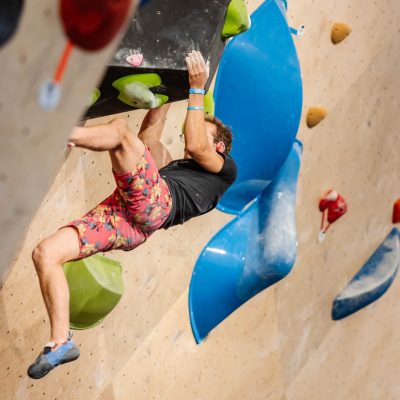
Monobloc references The Front's own sub-logo: the monobloc chair. White, stackable, and found everywhere—from front porches to café tables to backyard barbecues to the bouldering walls at The Front. Monoblocs are produced en masse and distributed globally, not unlike competition-style boulders, which draw inspiration from across the globe. These boulders reset once weekly, satisfying the hungriest climbers and adding up to more than 400 blocs to train on over the course of a year.
Reset Schedule
Each Friday, the route-setting team drops two circuits. The first is our Introductory Circuit, marked with blue tape and accessible to newer and intermediate climbers. The second is our Elite Circuit, marked with red tape and built for athletes training at competition level. Both circuits use World Climbing four-point starts and a zone hold, occupying wall space in a configuration unconventional for a commercial gym. A 4-on/4-off timer runs continuously in the space. New circuits stay up through Thursday evening and are stripped and replaced the following Friday.
B-Pump Ogikubo
The concept is directly inspired by B-Pump Ogikubo, a bouldering gym in Tokyo recognized for its commitment to competition-style movement at all ability levels. By capping each circuit to four boulders, the route-setting team has maximum creative freedom to explore movements not found elsewhere in the gym.
Feedback
Let us know how we're doing. Submit feedback on The Monobloc, climbing programs, and setting here.
What is World Climbing?
World Climbing is the International Federation of Sport Climbing. This governing body facilitates professional climbing events across the globe, including World Cups and Olympic events, and creates the standards that define how competitions are set and judged. The Monobloc uses World Climbing conventions so every problem climbs the way it would on a World Cup stage.
World Climbing Boulder Style
World Climbing bouldering is distinguished by low hold density and expansive use of wall space—a format that demands dynamic, powerful, and technically precise movement rarely seen in a standard commercial gym setting. Problems are designed to be attempted in a structured format: four minutes on the wall, four minutes of rest, mirroring the cadence of a World Cup isolation zone. Climbers are scored on their ability to reach the zone hold and top the problem, with attempts tracked across the field. Climbers can experience the Monobloc in flash format — watching other athletes work through each problem before attempting — or onsight, climbing with no prior information. All scores are recorded as flash attempts. See an example here.
How to Start and Climb Monobloc Boulders
Locate the start holds, marked with tape at the base of the problem. Begin with one point of contact on each marked hold: two hands and two feet, or any four-point combination that aligns with the markings. Some starts include a match, indicated with two marks on a single hold. When the timer signals the on-interval, climb. The zone hold is marked partway up the problem. Reach it and establish control to earn partial credit. Control the marked finish hold with both hands to top the problem and earn full points. Rest during the off-interval, then move to the next boulder.
Although we encourage climbers to experience the Monobloc in a 4 on/4 off format, anyone is free to experiment and climb these boulders however they choose. Just wait for any climber currently mid-circuit to finish before starting your own attempt.
Scoring
Each boulder offers two scoring opportunities: the zone and the top. Reach the zone hold and establish control to earn partial credit of 10 points. Control the marked finish hold with both hands to earn the full point value of the problem, 25 points. Attempts are counted—fewer attempts on a zone or top scores higher than more. Reference the full World Climbing scoring guide here, or climb score free if you so choose.
Is the Monobloc included with my membership? Yes. Full access to the Monobloc is included with all Front memberships, punch cards, and day passes at no additional cost.
When can I use the wall? The Monobloc is open to all members whenever the gym is open, unless it's reserved for a clinic, camp, workshop, or youth team practice. Closure signs will be posted when the wall is reserved. Check the schedule below for upcoming clinics, events, and closures.
How do I start a problem? Locate the start holds, marked with tape at the base of the problem. Begin with one point of contact on each marked hold — two hands and two feet, or any four-point combination that aligns with the markings. Some starts include a match, indicated by two marks on a single hold.
How do I score points? Reach the zone hold, and establish control for partial credit. Control the marked finish hold with both hands to top the problem and earn full points.
Do I have to use the timer? No. The 4-on/4-off timer runs continuously and the circuits are designed around that format, but you're free to climb however you choose. Just wait for any climber currently mid-circuit to finish before starting your own attempt.
When do new circuits drop? Every Friday afternoon. Problems stay up through Thursday evening and are replaced the following Friday.
Who sets the Monobloc? The Front's route-setting team sets both circuits each week. Guest setters and coaches will rotate in periodically—follow along on Instagram for announcements.
How do I give feedback on the setting? Submit feedback on the Monobloc, climbing programs, and setting here.