

Welcome to The Front. Come as you are, we’ll send you home stronger.
Children 13 and under must be supervised by an adult with a valid day pass or membership.
Visit the Front Desk any time for autobelay, top-rope belay, and lead climbing and belay tests. Visit between 4:00p – 9:00p on weekdays and 11:00a – 4:00p on weekends for best instructor availability. Belay tests may require a wait time based on staffing availability.
Need to learn a little more first? Sign up for one of our Ascent Series climbing classes like Intro to Climbing or Learn to Lead below.
Your day pass gives you access to climbing, yoga, group fitness, tai chi, and Jiu-Jitsu.
There’s always something exciting on the horizon here; check out the calendar before your visit.
Comprehensive fitness spaces, high-end design, and unexpected experiences is just how we do things.
Get unlimited access to everything we have to offer, like Studio 1396 and Member Bennies.
View official rules for visiting The Front Climbing Club here.
Yes, every person that enters The Front must have a waiver on file whether they plan on climbing or not. If you are under the age of 18 years old, a parent or guardian must fill out the waiver for you. Save time and fill out the waiver online.
Yes, every person over the age of 18 must present an ID with your name and a clear photo. The primary purpose of this policy is to prevent identity theft; specifically, to ensure that the person signing the waiver is who they claim to be. IDs are visually inspected to confirm identity. The Front does not scan, photograph, or otherwise store the presented ID.
No, The Front does not accept cash.
Find official rules and responsibilities for our dog areas here.
To utilize our facilities for commercial/promotional photography and videography, you must have a facility use agreement in place. Please email Marketing for more details.
Look at an entire problem before getting on the wall. This ensures the route doesn’t intersect with another climber’s route and helps to avoid running into someone already on the wall.
When on the wall, stay at least an arm’s length away from others and outside of their fall zones. Again, this is helped by looking at the routes other climbers are on before getting on the wall. Problems overlap and one problem may end directly above where another begins. Stay out of the fall zone!
Down climb a boulder problem, when possible. Every fall is a ground fall, so reduce the potential impacts by downclimbing rather than jumping off, when possible. If you do jump, please check underneath you to make sure no one is in your fall zone. There is no way to guarantee a safe fall while bouldering, but techniques have been developed over the years that may mitigate some injury risks. Attempt to fall in a controlled manner and use the following general falling guidelines:
Do not climb barefooted.
Do not wear climbing shoes into the bathroom.
Minimize chalk usage by shaking excess chalk in the chalkbag, not blowing it into the air. Better yet – give liquid chalk a try!
In the route climbing area, place water bottles and other personal items next to the wall, not in the middle of the floor.
The dot at the base of a route serves as a general guideline for what to expect. Like many other gyms, The Front’s grading system is intentionally broad to compensate for the individuality of climbing grades. The dots are present to guide one’s time in the gym, not impose a judgement of climbing ability.
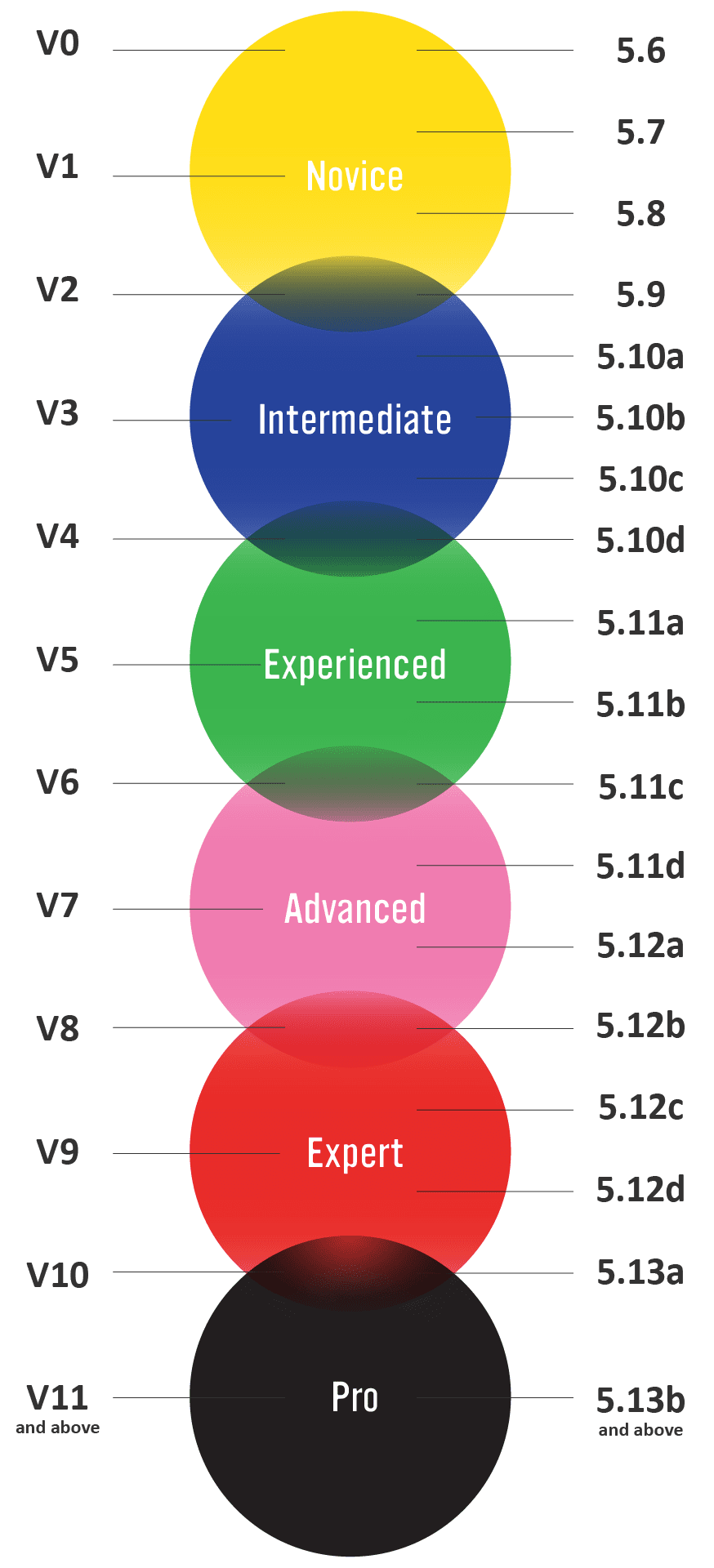
The Front uses a dot system to mark the difficulty level of a route. Generally, yellow is the easiest, blue is intermediate, green is experienced, pink is advanced, red is expert and black is hard… Yoda hard. The dots are placed at the beginning of each route and often indicate the starting hold. Posters in each climbing area will tell you how hard the ratings are numerically for both bouldering and roped climbing.
Once you choose a route to climb, follow the color of the starting hold(s) to the top of the climb. Using all of the same color holds to mark a route makes it easier to follow and is more environmentally friendly than taping underneath every single hold.
We have over 100 routes at the gym, and reset all of them every ten weeks – that’s the fastest resetting in the Wasatch!
Yes! We believe assisted braking devices (ABDs) are an important step forward in the evolution of climbing gear. ABDs provide an extra function to the belay device, that if used properly can help reduce the chances of a belay failure. (An example of an ABD is Petzl’s GriGri.)
Yes! You must pass our top-rope belay test if you are top-roping and our auto belay test if you’d like to auto belay. You must pass our lead climb and lead belay test if you would like to lead climb.
You are required to wear our harness tags when in the rope climbing area if you pass the tests.
Don’t worry if you don’t know how to belay or lead climb, or if you haven’t done it in a while. We offer top-rope orientation classes and lead classes. Learn more about climbing classes here.
Our bouldering walls reach up to 17 feet high. The tallest section of the roped walls is 70 feet high! Other roped sections are about 50 feet high.