
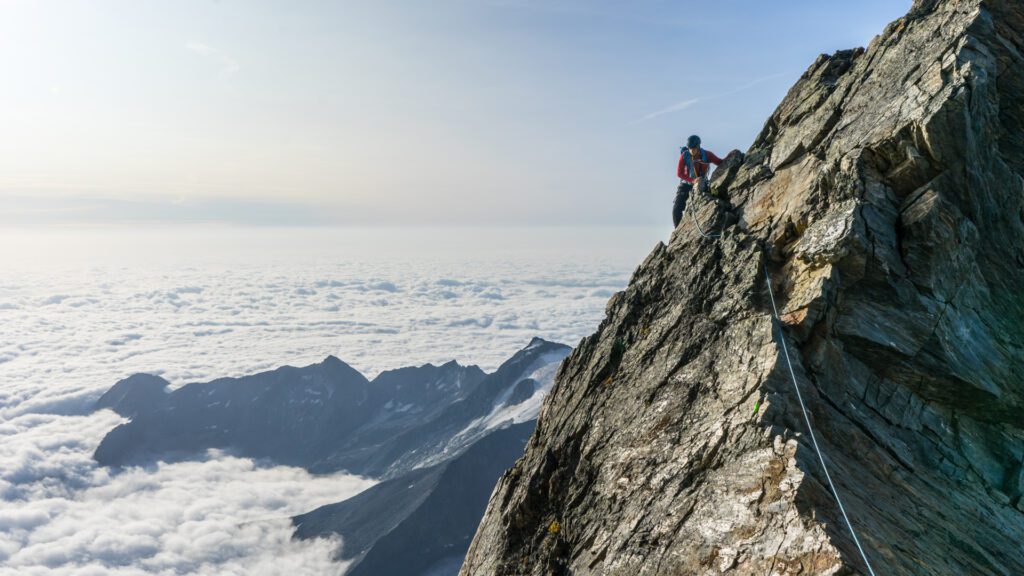
The mountains can be unforgiving, challenging any level of athlete.
On top of unpredictable weather and extreme terrain, as you ascend to higher altitudes, changing air pressure throws our bodies into wack as we adjust to this environment. Trouble sleeping, difficulty breathing, and the risk of potentially life-threatening illness not only impact our sports but can impact our health if we go too high too fast. As more people travel to higher altitudes for recreation, it is essential to understand what happens to the body.
Part 1 of this series will focus on the nature of these settings and their impact on the body, while Part 2 will cover how athletes can combat these changes.
What High Altitude Means
As you go to higher altitudes, the atmospheric pressure decreases. Earth’s atmosphere is 21 percent oxygen regardless of how high you go. Lower air pressure allows oxygen molecules to spread apart, impacting the oxygen composition in our blood; each breath we take has less oxygen than usual.1 A cascade of biological responses occurs rapidly to better survive in the new environment, referred to as acclimatization.2 Some changes occur immediately to compensate, yet several body systems take upwards of two weeks to shift to their new balanced state.
How High Altitude Affects The Body
First, our heart rate and breathing speed up to move more oxygen to the brain and body. Activities like running feel more challenging compared to lower altitudes due to this.3-4 Resources are redirected in our body to re-balance; on the surface, this shows up as uncomfortable symptoms that, if ignored, could lead to serious illness. Although we need more food and water to fuel the adaptation process, we may not have an appetite or feel thirsty; this is partly why people experience dehydration symptoms like nausea, dizziness, and fatigue.4-6 Further exacerbating this, sleep quality can be disrupted due to less oxygen availability for the brain. These changes occur at rest and during physical activity yet are more prominent during exercise.4, 7-8
The primary driver of long-term acclimatization is the production of more red blood cells, which deliver oxygen to our brain and body. Like your smartwatch, our body has sensors that sense the changing air pressure at different altitudes, stimulating red blood cell production. Over time, the accumulation of these cells alleviates the symptoms that make higher altitudes less comfortable and eventually match the environment. Your body will keep these oxygen-moving cells until you return to lower altitudes, but they can stick around for up to two weeks.9
This shift can go from uncomfortable to sickening if you rapidly ascend to a new altitude. Symptoms may become intolerable, resembling a hangover, referred to as acute altitude sickness (AAS). Symptoms such as vomiting, headaches, and lightheadedness can be alleviated by descending to lower altitudes.10-11 Yet, if ignored, it can spiral into life-threatening conditions like high-altitude pulmonary edema (HAPE) or cerebral edema (HACE). Weakness, coughing, confusion, and lack of coordination indicate a medical emergency; it’s time to get supplemental oxygen or go down to lower altitudes.10-11
Understanding what happens to our bodies is essential to our health and performance when we embark on these environments. This is especially true for sports; preparing our bodies helps us safely achieve our goals and gives us the upper hand. Next, learn what can be done leading up to and during high-altitude travel to feel our best as we work and play in these settings.
References:
- Richalet, J. P. (2020). CrossTalk opposing view: Barometric pressure, independent of, is not the forgotten parameter in altitude physiology and mountain medicine. The Journal of physiology, 598(5), 897-899.
- Moore, L. G. (2017). Measuring high-altitude adaptation. Journal of applied physiology, 123(5), 1371-1385.
- McClelland, G. B., & Scott, G. R. (2019). Evolved mechanisms of aerobic performance and hypoxia resistance in high-altitude natives. Annual review of physiology, 81, 561-583.
- Richardson, A., Watt, P., & Maxwell, N. (2009). Hydration and the physiological responses to acute normobaric hypoxia. Wilderness & environmental medicine, 20(3), 212-220.
- Lippl, F. J., Neubauer, S., Schipfer, S., Lichter, N., Tufman, A., Otto, B., & Fischer, R. (2010). Hypobaric Hypoxia Causes Body Weight Reduction in Obese Subjects. Obesity, 18(4), 675–681.
- Matu, J., O’Hara, J., Hill, N., Clarke, S., Boos, C., Newman, C., … & Deighton, K. (2017). Changes in appetite, energy intake, body composition, and circulating ghrelin constituents during an incremental trekking ascent to high altitude. European journal of applied physiology, 117(9), 1917-1928.
- Nussbaumer-Ochsner, Y., Ursprung, J., Siebenmann, C., Maggiorini, M., & Bloch, K. E. (2012). Effect of short-term acclimatization to high altitude on sleep and nocturnal breathing. Sleep, 35(3), 419-423
- Weil, J. V. (2004). Sleep at high altitude. High altitude medicine & biology, 5(2), 180-189.
- Paralikar, S. J., & Paralikar, J. H. (2010). High-altitude medicine. Indian journal of occupational and environmental medicine, 14(1), 6–12.
- Taylor, A. T. (2011). High-altitude illnesses: physiology, risk factors, prevention, and treatment. Rambam Maimonides medical journal, 2(1).
- West, J., Schoene, R., Luks, A., & Milledge, J. (2019). High altitude medicine and physiology 5E. CRC press.

By Beverly Albert, MSc, CSCS
Certified Strength and Conditioning Coach and Educator
Beverly is a Ph.D. student, sports scientist intern, and ultra-endurance athlete. Her experiences pushing her possible in the mountains drew her to dedicate her life to studying extreme environments and teaching athletes practical skills to do the same.


