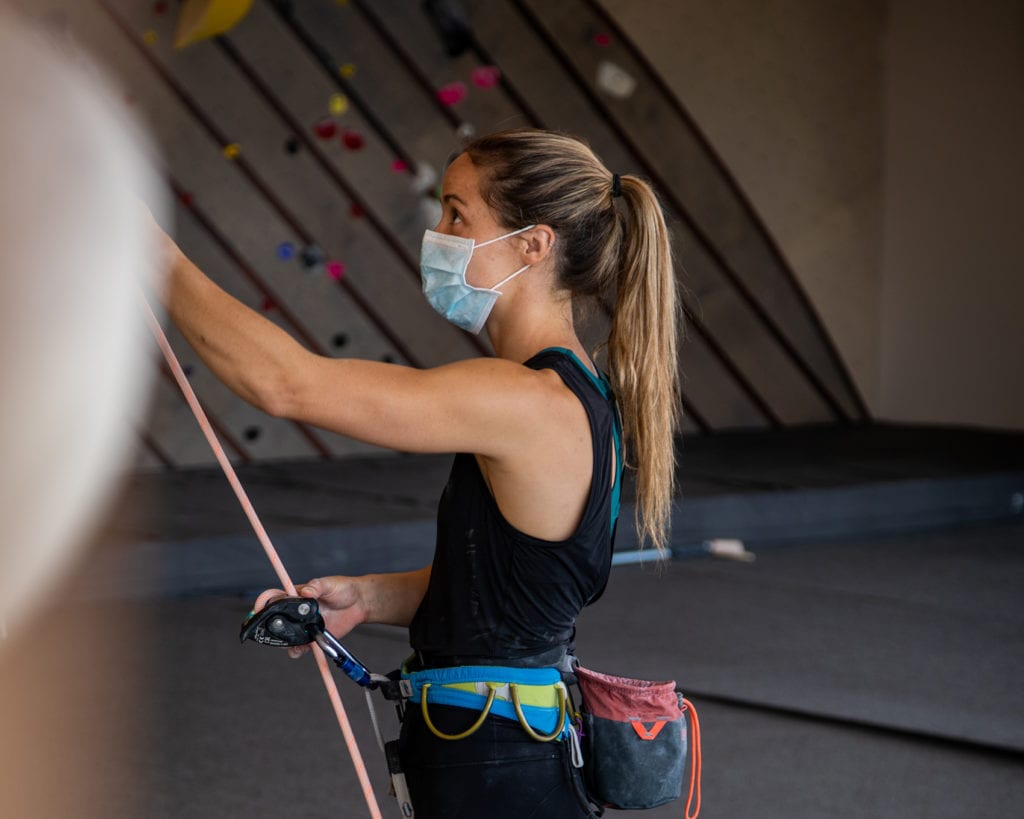
The Front requires that everyone who visits wears a mask at all times, including while climbing. Although this may be uncomfortable initially, it is also an opportunity to improve several aspects of our climbing. This article focuses on improvements to your climbing routine through better communication, rope management, and clipping; all of which help your climber/belayer partnerships and mental game, whether inside or outside.
Communication
You may have noticed that wearing a mask while climbing can muffle our voices in an already noisy environment. One step you can take to improve our communication skills is to be more direct by using each other’s names, hand signals, and a louder voice.
Good communication is direct – climbing partners should be straightforward with each other through verbal and non-verbal communication. For example, non-verbal communication can be direct by keeping attention on our climbing partner and making eye-contact when possible.
Additionally, obvious signals such as shaking your head “yes” or “no” are easy to identify and interpret. Pro-tip: using belay glasses can increase comfort and ability to communicate with each other non-verbally by allowing you to more easily see your climber (and they are available in our gear shop!).
Ground Rules
It’s also helpful to discuss any ground rules for communicating with your partner before leaving the ground. Here are some ideas of what to discuss with your climbing partner:
- How you plan to acknowledge each other while climbing?
- What commands or hand signals you will use?
- What parts of the route may be crux moments during which communication may be strained or discussed prior to you leaving the ground?

We understand that even during non-pandemic times, these communication skills are important to overcome challenges in signaling between climbing partners. For example, imagine a raging river, thick winter clothing, or when the climber moves out of sight of the belayer – all times when clear verbal communication may not be possible. We suggest wearing a mask while indoor climbing can be an opportunity to practice these communication tactics that will benefit your climbing for years to come.
To Bite Or Not To Bite?!
Biting the rope while pulling up slack to clip is a typical lead climbing practice that is, of course, harder to do while wearing a mask. Rope biting is often used when a climber is unable to pull up enough slack to clip the next quickdraw when it is in-reach above our heads, so they bite the rope, then pull another length of slack to reach the next clip. Clipping when the next bolt is above your head creates a mini-top-rope experience before a climber enters the next section, which can give the climber a greater sense of security. This practice is known as “high-clipping”.

High-clipping is acceptable in many instances, such as when clipping from a confident stance before entering into much less secure terrain. However, when performed as your primary lead method or haphazardly, it can pose more significant risks. For example, falling with the rope clenched in their mouth, climbers, such as Steph Davis’s dental hygienist, have ripped out their front teeth.
Similar alternatives include pinching the rope between our chin and chest or reaching further down the rope before pulling up slack. Regardless of how the rope is held, each technique can result in a longer fall due to excessive slack in the rope system. This is especially problematic if it occurs close to the ground or above an obstacle, such as a ledge.
Climb Higher to Fall Shorter?!
While somewhat counter-intuitive, climbing higher before making the next clip can often reduce our fall distance. Imagine the following:
Falling when clipping closer to your waist: A climber has three feet of rope out between their tie-in point and most recent clip. If they fall, it will equal the three ft. distance above the last clip and three ft. distance below the clip. Including rope stretch, the normal slack in the system and the dynamic nature of the average lead, the total fall length would likely be between eight and ten feet.
Falling while high-clipping: In this scenario, often using rope-biting, a climber’s fall length could be much greater. Imagine this climber has the same three feet of rope out to the last clip, and they fall while attempting to clip a draw one foot above their head. The distance from the climber’s tie-in point to the next draw is about three-and-a-half feet. Since the rope remains tied to the climber while being pulled, an ever-increasing “peak” of rope starts to build. Eventually, the three and a half feet of extra rope from the last draw to their hand are joined by the additional three and a half feet from the other side of their hand down to their tie-in point, which amounts to seven extra feet of rope introduced to the fall. This could quickly turn the original eight-to-ten-foot fall into a twenty-foot one.
Clip Better!
Our hope is that you take away several tools from this lesson to help you maintain awareness and manage fall distances while lead climbing. While “clipping at the waist” is not always practical, “clipping between the waist and chin” is more so. This means it’s okay sometimes to clip low and sometimes to clip a little high, and then extreme high-clipping becomes the exception rather than the rule. In addition to clipping height, climbing higher into a more confident stance can make for easier clipping. Also, thrust your hips up as we clip can make better use of the slack that is already in the system. Increasing our awareness of fall distances and how to mitigate them with varying belay techniques is also essential.
There is no one perfect approach to clipping technique for all the scenarios climbers face. The important part is understanding and incorporating good partner communication and fall height management into your climbing routine and toolkit. If you want to learn more about these concepts, The Front’s Learn to Lead class covers all of these topics and more. The Front offers special member pricing, so please ask a staff member for more information, and thank you for masking up out there!


