Over the past year of introducing members of the community to the Jiu-Jitsu Collective at The Front, I’ve found that the reactions to the new offering all seem to fall into one of three categories.
The least surprising is the look of mild confusion as the apparent contrast between a nominally non-contact sport and a full-on combat martial art raises the inevitable question of ‘How is Jiu-Jitsu relevant to rock climbing?’ Less expected is that almost as many people immediately tell me about their own martial arts or grappling backgrounds. It may surprise you that an impressive number of climbers share the common experience of wrestling people before pebbles. The rest of the questions tend to revolve around concerns about injury prevention and whether Jiu-Jitsu really fits into a sustainable training program for climbers.

When we talk about climbing as a sport, one of its most defining attributes is its demanding and multifaceted nature. Physically, it engages the entire body and requires switching from slow, controlled endurance-type movements to powerful, coordinated, dynamic movements moments later. In sports physiology terms, not only does it make use of the entire body, it requires that we maintain and switch seamlessly between aerobic (energy produced using oxygen) and anaerobic (energy produced without the use of oxygen) systems. Climbing is a technically demanding sport, as well, in which we master many specific skills from basic foot placement, to crosses, heel-hooks, and paddle-dynos. Additionally, there is a significant mental component requiring focus, attention to detail, continuous assessment of risk, and management of fear response. Finally, even if you never compete formally, every climber knows that taking down a major project requires tactical skills: route reading, pacing, skin management, and even sleep and nutrition come into play (whether you’re new to the sport or gearing up for Tokyo next month). Often the level of engagement, complexity, and ever-changing nature of the challenge are what draw us to the sport in the first place. Interestingly, this unique balance of demands is one of the things that makes Jiu-Jitsu so relevant to rock climbing.
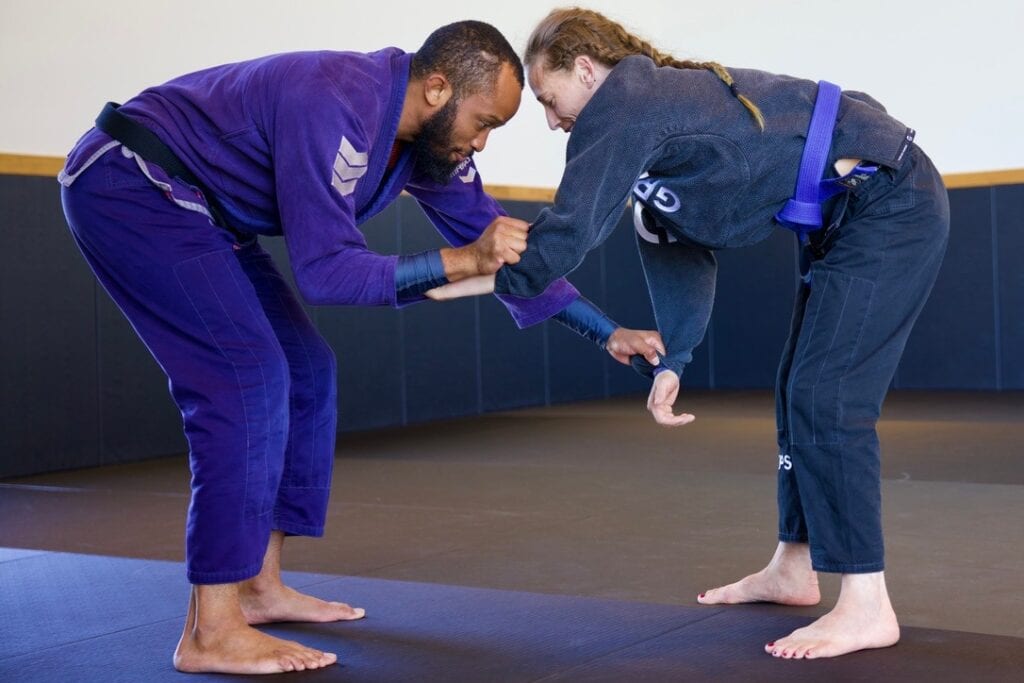
On a physical level, Jiu-Jitsu concerns itself with the same basic principles of contact, control, and movement initiation. Yes, the usable surface of a handhold is instead a body part or clothing. While this contrast may seem vastly different, when looking beyond it, there are compelling similarities in movement patterns. Both climbing and Jiu-Jitsu are essentially unrestricted in the active planes of movement. Contact is made and control established simultaneously with hand grips and foot contact, both pushing and pulling in a variety of directions to achieve a new position. In climbing, this is dictated by the holds on the wall, in Jiu-Jitsu by the reaction of the opponent, which amounts to holds on a person. Considering the sports from this perspective, the number of climbers who have either wrestled or trained in other combat arts makes sense. Those who excel in the sort of coordinated, problem solving required for one, are generally well equipped for the challenges of the other, with climbers perhaps having a bit of the upper hand due to the heights factor!
Perhaps due to the similar demands of these sports, there are also some interesting cultural parallels. Both sports are notably focused on long-term participation and the idea that one progresses in them slowly and steadily so long as they continue to show up and participate. It follows that injury prevention and mutual concern and respect for our community members are core values of both sports. Climbing and Jiu-Jitsu each involve a significant degree of risk; one revolving around falls and management of safety systems, and the other, joint locks, chokes, and shorter, but often ‘assisted’ falls. There are potentially unpleasant consequences in both and, as a result, both sports have developed a strong culture of respect and responsibility.

As climbers, we are constantly assessing the risk involved in our climbs: the likelihood of success for a given move versus the potential for injury. We also consider the skill level of the partner belaying or spotting us and, for many of us, this belayer/spotter – climber relationship is one of the most pivotal factors in our decisions on the wall. That relationship has a direct parallel in the Jiu-Jitsu training partnership. It is critical to be able to trust a partner to safeguard our health and safety as much as their own. Just as a climber may choose to climb more conservatively with an unknown or less experienced partner, in Jiu-Jitsu we take fewer risks and tap to concede and end a match sooner and more often if we are unsure whether our partner has the awareness and skill level to avoid causing harm. In both of these sports, we selectively choose to put our well-being in the hands of our partners and foster a strong sense of responsibility to our partners and community in order to support each other in the common goal of continued enjoyment of the activities we value so highly.
While climbing and jiu-jitsu may seem an unlikely pair at first glance, a closer look uncovers a lot of parallels. The physical demands and movement patterns complement each other well, making the sports relevant cross-training for each other and an excellent change of pace for experienced practitioners of one. Being a beginner in something often helps us train ourselves to develop new skills and is a beneficial practice for experts in any type of skilled activity. The similar attitudes and values of the sports make the transition of trying something new smooth and add to the value of having jiu-jitsu included in our offerings at The Front!
So, if you’re a climber looking for something new or have ever considered checking jiu-jitsu out, you might just find it fits you better than you expected.
Learn more about The Jiu-Jitsu Collective at The Front South Main here!

By Kelsey Hanson
Youth Intermediate Team Head Coach


