
What did you miss?
Salt Lake City hosted its biggest climbing competition in years not once, but twice, back-to-back the past two weekends! The downtown Salt Lake venue, Industry, successfully housed a few thousand spectators, as well as food trucks and booths from outdoor companies like The North Face and Petzl. If you missed it, keep reading to get the rundown on all the action and click the links to see the highlights!
1 // Week-One: Bouldering Qualifiers and Semi-Finals
Qualifiers
The United States came out swinging with strong performances from both genders in the cool, rainy conditioned qualifiers. For the women, Kylie Kullen, Sienna Kopf, Megan Lynch, Brooke Raboutou, and Natalia Grossman all qualified for semifinals, taking up an impressive quarter of semifinalist spots. Grossman had just placed third at the most recent World Cup in Meiringen, Switzerland and was last year’s national champion. In the men’s field, Olympian Colin Duffy, of Colorado, and young veteran Sean Bailey were the only two advancing to the following round of competition.
Semi-Finals
Semi-finals was an intense, action-packed round, as the top 20 men and women cycled through a total of 8 problems stretched across the competition wall. Natalia Grossman and Brooke Raboutou, two best friends and college students who’d grown up climbing together on Team ABC in Boulder, Colorado, took the top two spots in finals. Grossman asserted her dominance by being the only athlete to complete all 4 problems and did so in only 6 total attempts. Two Austrians, Johanna Farber and Jessica Pilz followed closely behind Raboutou by only attempts. Lastly, Miho Nonaka of Japan and French wunderkind Oriana Bertone rounded out the top 6 moving to finals.
Semi-Finals was an intense, action-packed round, as the top 20 men and women cycled through a total of 8 problems.
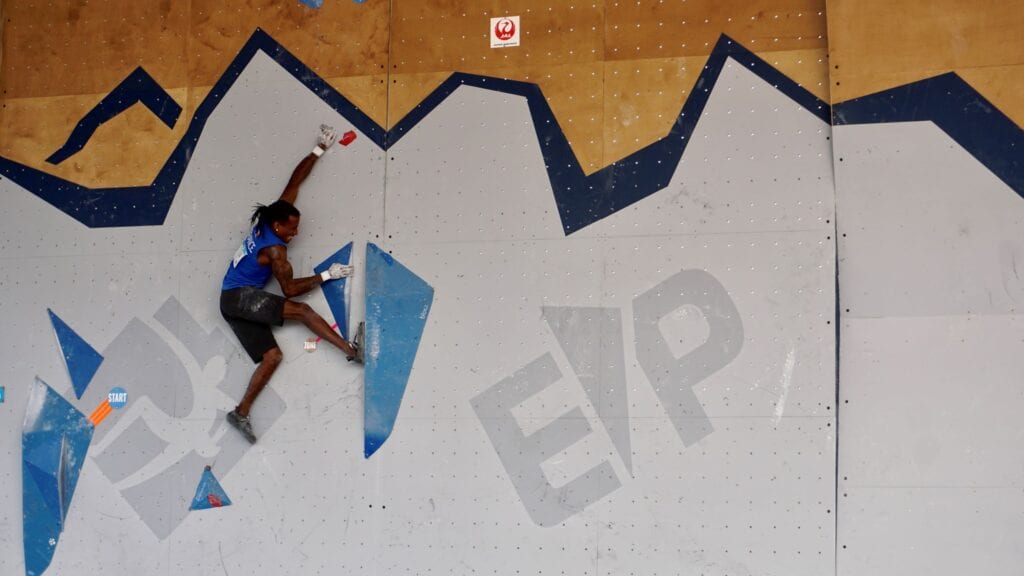
Kokoro Fujii had an excellent round for the men, powering through 3 of the 4 very physical problems presented by the route setters. The world’s best climber, Adam Ondra of The Czech Republic tailed him, with previous world cup winner Gregor Vezonik, old guard and all-arounder Jakob Schubert, and Slovenian Anze Peharc following close behind. Having only made one semi-final last year, the relatively unknown 17-year-old Mejdi Schalk of France took the 6th spot with tremendous power and execution.
2 // Week-One: Bouldering Finals
The women were first up to bat in finals and began their round with a technical slab which was topped by five of the six competitors. The second problem began with burly volume compression which led to a tenuous stand up move off the big E-Grips bubble wrap wave . This problem was maybe a bit too easy, as again, 5 of the 6 athletes topped. Problem 3, a rather basic looking red slab, required sticky skin, subtle body positioning, and power, the crux of which was only surpassed by Americans Raboutou and Grossman. The crowd was exuberant at the prospect of an American making podium (a rare occurrence, on the international stage). Raboutou and Grossman were all but tied going into the third and final boulder. It began with a massive, crowd-pleasing leap to a good edge on a volume. With an early ascent by Bertone, the pressure was on for the Americans as Bertone had taken the lead. Raboutou, despite her best efforts, could not get the distance required for the first large jump.
As Natalia came centerstage the tension in the crowd was tangible. Everyone knew it- all Natalia Grossman needed to seal the deal on her first World Cup victory was to latch the dyno (jump). Grossman pulled on for a climactic flash attempt, only to have her foot slip on the jump. She continued to put 9 unsuccessful attempts in a row within 3 minutes. The crowd’s hopes were dashed, as Grossman did not look close to sticking the move and was only getting more exhausted with each effort. The 19-year-old crossed her arms, looked at the problem with determination, and let out a deep breath.
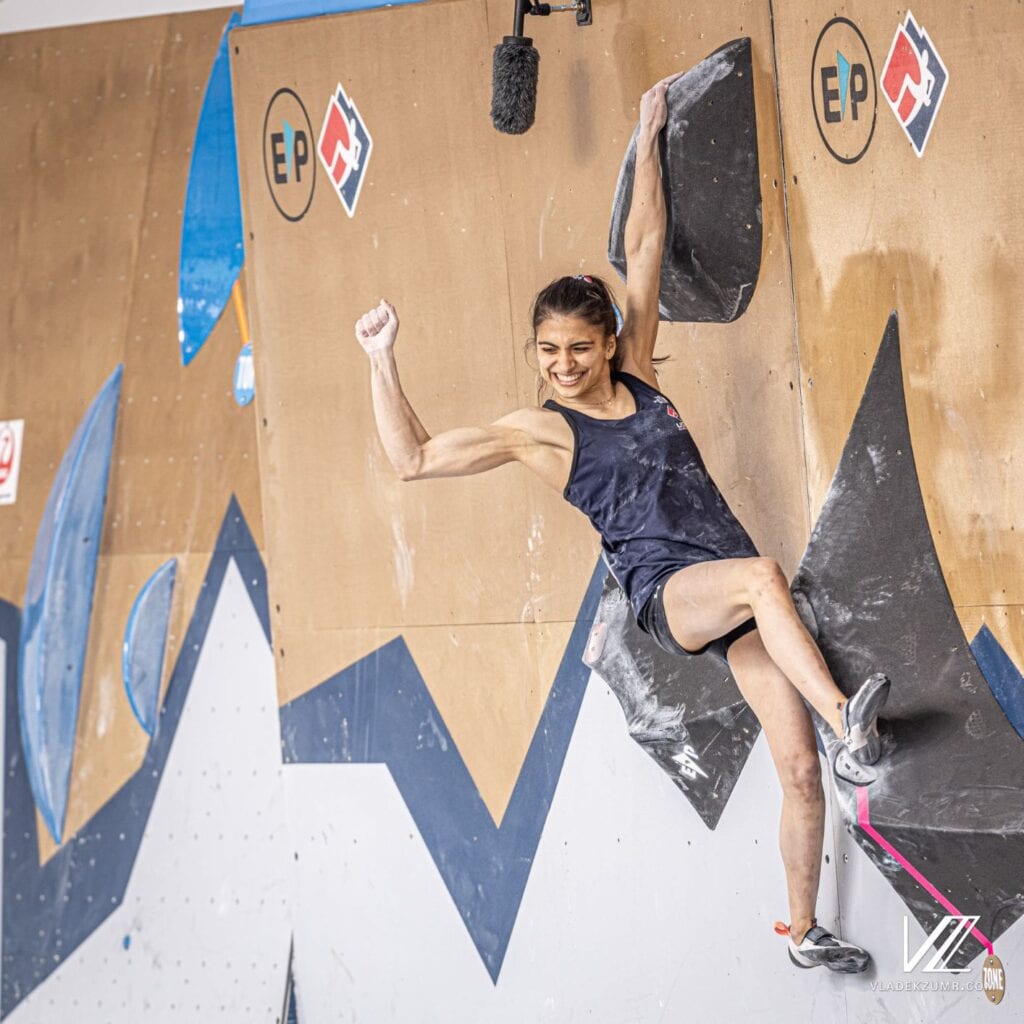
With 45 seconds left on the clock, Grossman pulled on, planted both feet on the small triangle volume, and pounced with all her might. Miraculously, she made contact with one hand, then two, and held the near-horizontal swing. By sticking the zone, she had just won gold, but she didn’t know that. Grossman feverishly scrambled up the remaining moves and mantled to the finish hold for a top! Natalia Grossman had done it! Tears of joy ran openly from Natalia as she pumped her fists to the uproarious crowd of proud countryfolk who’d just witnessed a hard-fought dream come true. Grossman had hardly had time to catch her breath before she was impacted by a powerful embrace from her equally emotional BFF and bronze medal winner Brooke Raboutou. Nonaka and Bertone joined in on the group hug in a truly beautiful moment. Watch it here.
Meanwhile for the men, Mejdi Schalck, the 17-year-old French climber, showed his strengths on problem one by flashing to the bonus on an incredibly lateral run-across dyno. His buoyancy only got him so far, as a microscopic foot jib stymied him on his quest for a top. Ondra, Fujii, and Peharc were all able to secure a send. The second problem, a delicate slab that required athletes to rock over a bad foot laterally, was a bit undercooked, as every competitor topped without much trouble. Problem 3 began with a spectacular and tricky to read overhead foot cam. If the competitors figured out the method and could complete the first two moves, they were able to finish the rest of the problem easily. Schalck, Schubert, and Ondra topped the route. In typical style, the fourth problem was a show of power! Featuring two arete-smacking double clutches (two-handed dyno) and a thuggy bicep section, it was a display of pure strength. Young Mejdi once again brought the excitement early in the round with an emotional flash and subsequent celebration. Adam Ondra proved his dominance by cruising the problem and taking first place over the teenage Frenchman.
3 // Speed Climbing
For the men:
The first speed world cup of the year was eagerly awaited as athletes had been perfecting their sequences and ramping up their power for the past year of quarantine. The internationally standardized 15-meter wall has been in use since 2007, with Russians, Chinese, and Middle Eastern countries having shown dominance across the board. Men’s qualifiers started off with a bang Friday, as 20-year-old Kiromal Katibin of Indonesia made his adult world cup debut with a world record run! Clocking in at 5.258 seconds, Katibin surpassed Reza ‘The Fastest Vertical Man in The World’ Alipour of Iran’s 2017 record by two-milliseconds, a huge margin for the sport.
The excitement brought by Katibin electrified the venue and set the tone for an exhilarating qualification round. American favorite and 6x national champion John Brosler of Texas was looking in top form. Despite having a slip on his first run, he was able to recover and put-up a new American record of 5.606, securing him a third-place qualification placement.
Throughout the seeding rounds many slips were had, but two athletes were consistently error-free. In finals, Katibin squared up against fellow Veddriq Leonardo who had been hot on his teammates heels all day. In a split instance, the two men shot up the wall in a blur of red and white above a roaring crowd. Leonardo smacked the buzzer in a gob smacking time of 5.208 seconds, breaking his compatriots record from earlier in the day and ushering in a new dominant duo in male speed climbing.
John Brosler was in outstanding position to take home the bronze medal as he neared the top of the speed route, but an untimely slip yielded the medal to Marcin Dzienski of Poland. John told us, “I wanted that medal badly, and I knew that Marcin was a seasoned competitor that was capable of posting an incredible time. I certainly recognized the significance of the situation which led to lots of conflicting emotions and nerves. However, I had confidence in my ability to win that race and could do nothing but trust myself and my preparation in that moment.” John is now looking forward to competing in the 5 remaining world cups free of expectations for himself, “I’m just psyched that I feel like I’ve established myself as a real contender on the circuit for the first time. Pushing the limits at the international level feels like the next step!” We can’t wait to see your success, John!
Rumor is the Indonesian athletes have been seen hitting unofficial numbers as low as 5.05 in practice, indicating that we are within sight of the long-awaited and highly debated sub-5 second run. Click here to view the competition calendar- you will not want to miss the first ever 4-second run or John Brosler’s quest for the podium.
For the women:
While the men’s round was hard to beat, the women’s speed competition had its moments of tension and glory as well. Early in qualifiers, Emma Hunt from Stone Summit in Georgia smashed a national record with a PR of 7.52 seconds.
In the final, she battled head-to-head with future Olympian and speed specialist Ola Miroslaw of Poland. Miroslaw came out dominant, but in securing silver, Emma solidified the United States’ position as a threat on the speed wall. Miho Nonaka, a Japanese bouldering specialist heading to the Olympics, had a stellar performance having placed third, for her first speed medal on the world stage. Her success is a promising sign for her odds of winning gold in the combined sport climbing format for the Tokyo 2021 Olympics.
The current women’s speed world record is held by Iuliia Kaplina of Russia, with the time of 6.964 seconds.
4 // Week-Two: Bouldering Qualifiers and Semi-Finals
The second weekend of competition promised to be just as engaging, with numerous new competitors such as Slovenia’s phenom Janja Garnbret coming to town. Crowd favorite and winner of the past two world cups, Adam Ondra announced that he would be withdrawing from the competition due to a shoulder tweak, and the previous weekend’s finalist, Austrian Jakob Schubert flew back overseas to continue his training for the Olympic games.
Saturday’s qualification round required good execution and time management, as the problems were trickier than they were difficult. As a result, competitors needed to send at least 3 of the 5 climbs to advance. American’s Nathaniel Coleman, Zach Galla, and Sean Bailey made it through for the men, and last week’s champ Natalia Grossman, Olympians Kyra Condie and Brooke Raboutou, and Kylie Cullen made it onto Sunday’s events as well.
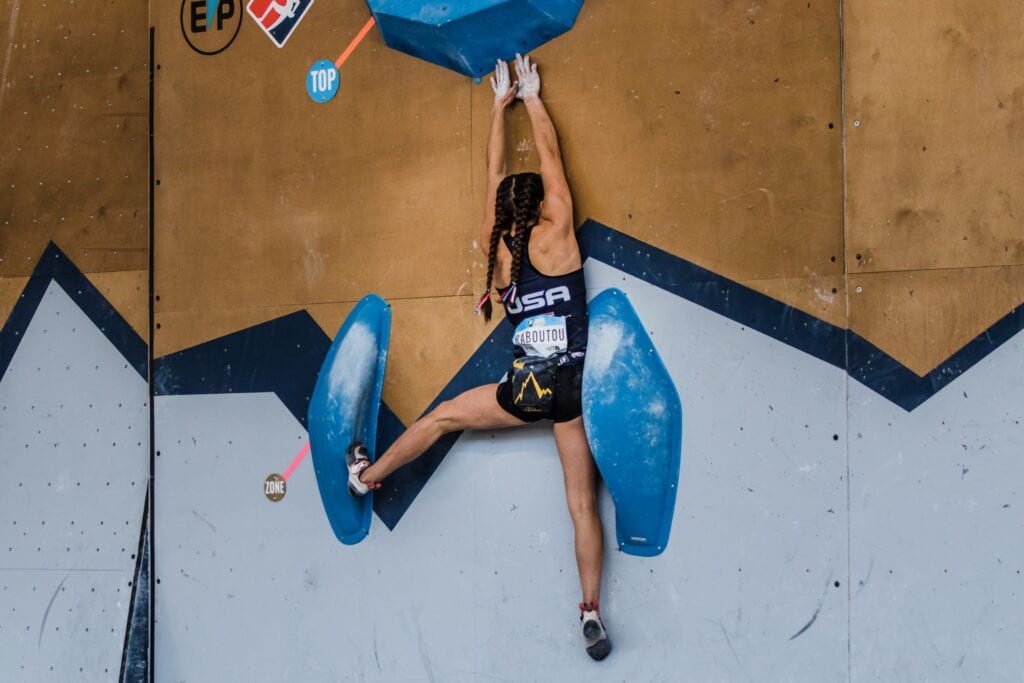
The semi-final was one of the most well-set, entertaining, action-packed rounds of competition climbing of the season! With drama and tension up until the final competitors, spectacular emotional performances, and jaw-dropping, futuristic movement, everyone was on the edge of their seats. Highlights included Brooke Raboutou nabbing the only ascent of the contorted, committing problem 3, and British showmen Max Milne and Alex Waterhouse showing their passion with hard-fought tops.
Sean Bailey from Washington state remarkably held onto the finish hold on problem 4 for his fourth top of day, securing his spot in finals. Meanwhile, Zach Galla, who had recently undergone shoulder surgery, flashed the first three problems in great style to make his first final. Natalia Grossman, despite her victory last weekend, just barely nabbed the 6th spot in finals. With Grossman’s inclusion, national pride was on full display, as 1/3 of all 12 finalists were from Team USA!
5 // Week-Two: Bouldering Finals
The men’s final round was a bit of a slog. With low cruxes and very few tops, it was clear that the setters had cooked these problems a bit too hot. Kokoro Fujii and Sean Bailey both were able to stick the paddle dyno and send problem one with just seconds remaining. The next two problems were too hard, with no one making noteworthy progress beyond the zone. The fourth and final problem culminated in a showy, ultra-dynamic moon kick coordination dyno. Due to his ascent of problem one in fewer attempts than Fujii, Bailey only needed to secure the zone hold to win, but he was hungry for more. He smashed the final problem with striking finesse for his first world cup victory! Sean had previously placed 2nd at the Vail world cup in 2018.
The big story on the ladies’ side was whether the reign of Janja Garnbret would come to an end. At just 22, Garnbret is the most winningest female competition climber in history. Last season, she became the first-ever competitor to win all 6 bouldering world cups in a season- topping 74 of the 78 boulder problems that season.
Problem one, a techy slab featuring a delicate foot swap and committing last move was topped by 5 of the 6 athletes. Grossman came out first for problem number two and flashed it handily as she had the with the first problem, setting the standard for the climbers to follow. The favorite, Garnbret, topped, but not without an unfortunate slip on the beginning. Grossman continued her dominance with yet another flash on the third climb, a test of weight transitions and press strength on large dual-tex holds that had been baking in the sun. Garnbret matched her performance with fantastic style.
Approaching the fourth and final problem, Natalia Grossman had the opportunity to clinch a perfect round and her second consecutive gold medal. Wide compression led to a cryptic middle section and a balance-y rock-over to gain the top. Grossman was pensive, trying to figure out a static method for the middle, before fully committing to a two-handed, horizontal double-clutch and inching her way with the tips of her fingers to secure the finish! Watch her seal the deal and end Janja’s multi-year dominance here. Garnbret also flashed the problem, but due to her earlier slips, she took second place, followed closely behind by Brooke Raboutou.
Two American gold medals was more than anyone might have hoped for, and the collective joy in downtown Salt Lake echoed for many hours and days to follow. We cannot wait to see what is in store for Team USA throughout the rest of this season and in the Tokyo Olympic games in just a couple of months!

By Eric Jerome
Marketing Assistant


