Don’t Train in Vain: Demystifying The Front’s Training Tools
October 29, 2021
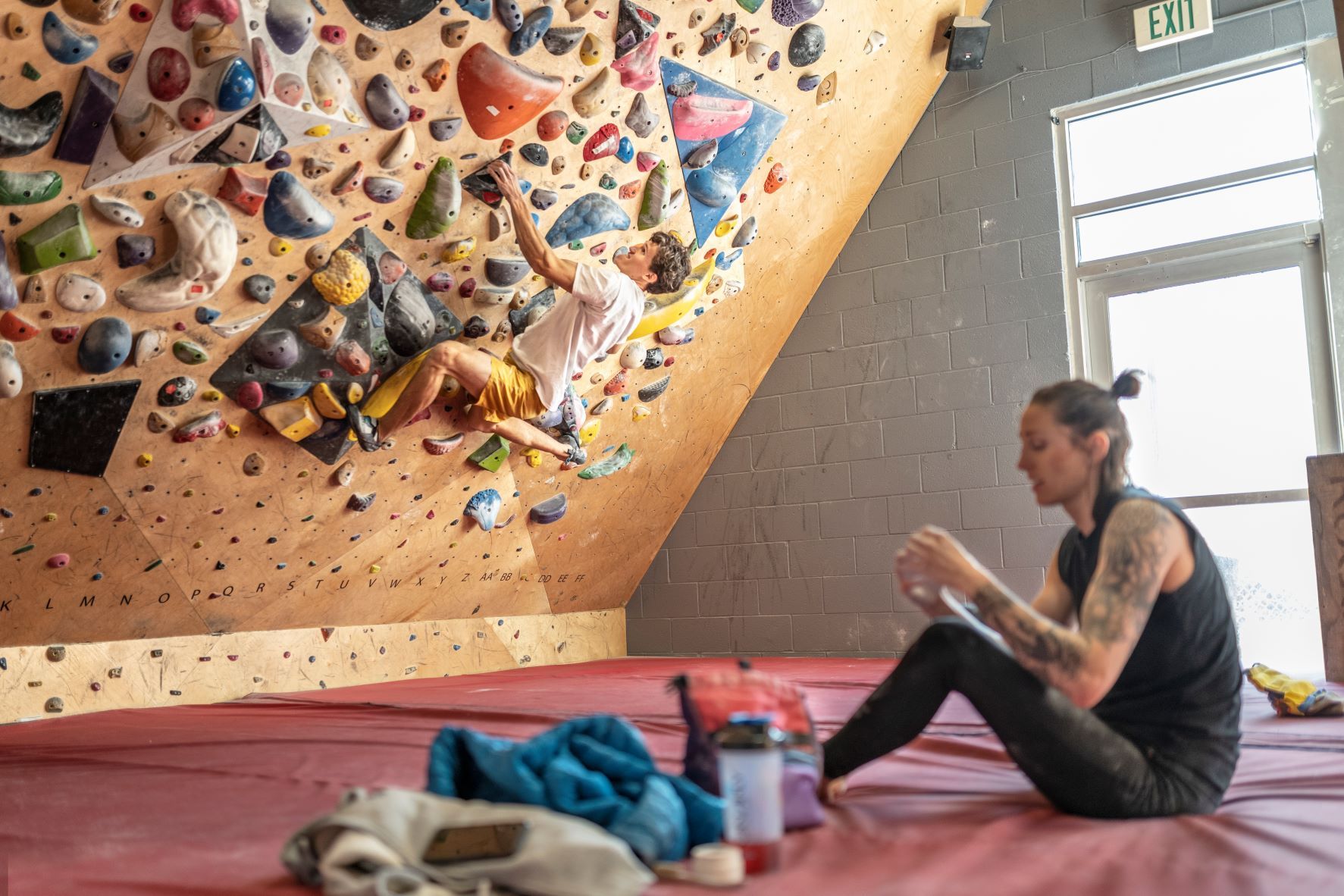
Intimidated by our training spaces?
When it comes to elite rock and competition climbing, Salt Lake is one of the leading cities in the world. Here at The Front, we've established our three locations as world-class training facilities, where Olympians, World Champions, National Champions, and some of the industry's top outdoor climbers all train, climb, and hang out.
Intimidating? We get it. The good news is, you don't have to be a pro climber to enjoy the benefits of our training tools. We're here to break it down for you and help you take full advantage of our space. To start, we'll give you a rundown of the climbing-specific training tools that you’ll find across all three Front gyms. Then we'll get into the tools that are specific to each space.
1 // The Hangboard
Ah, yes. Where would we be without our trusty hangboards? These guys are perhaps the earliest form of climbing training, and certainly one of the most effective (besides climbing, of course).
Put simply, hangboards are a tool designed to be, well, hung from! There is a misconception that hangboard training is dangerous, particularly for beginner climbers. However, when done properly and mindfully, hangboarding can be one of the safest and most protective forms of training. In many ways, it is far less risky than climbing, as it takes velocity out of the equation.
Climbing is a skill sport first and foremost, so generally, yes, if you are new to climbing, the best thing you can do for your climbing is to log hours on the wall and learn how to move with technical efficiency. That being said, supplementing your climbing with fingerboarding is a solid way to improve your overall grip strength.
Your fingers are your connection to the wall, and therefore, are arguably the most important element of any climber’s success. You can modify the intensity of your hangs by either reducing the load hung using a pulley system or increasing the intensity by adding weight to your body. There is LOTS we could talk about in terms of the intricacies of hangboard training, but that would be another blog post (or 10). Most broadly, if you are danglin’, you are probably getting stronger. Just remember to keep the volume low and err on the side of caution. You’ll never regret doing too little, but you will always regret that time you got injured while training.
Here's some recommended literature if you’re interested in learning more:
Fingerboarding & Hangboarding: A Beginners Guide, Hangboarding: A Way, Dave Macleod's How to Hangboard,

2 // The Spray Wall
We LOVE a good spray wall. Fortunately, all three Front locations have great ones! Our personal favorite is the South Main board, which features some amazing slick wooden holds from Beastmaker.
So what is a spray wall? Spray walls are simple, single-angle boards littered with holds off all different shapes, sizes, and orientations. They're great strength-training tools. While technical climbing skills like toe hooks and drop knees are best practiced on the three-dimensional problems crafted by our setting team throughout the rest of the gym, the spray wall is a space to really simplify your movements and focus on your contact strength, power, full-body tension, and foot power.

This tool is a blast to climb on and make up problems with a couple of friends. People tend to create problems that suit their style, so climbing with others provides a good opportunity to work on your weaknesses. The focus of these sessions should be pulling hard.
See the following additional resources to learn more:
Ned Feehally's new book Beastmaking, Kris Hampton at Power Company Climbing has lots of good articles and podcasts on the subject, and see how Adam Ondra, the best climber in the world, utilizes a spray wall.

3 // The Campus Board
The campus board, created in Germany by phenom Wulfgang Gullich, is designed to improve power and contact strength. Campusing is done by climbing without the use of your feet, therefore putting all the load on your upper body. Be it laddering, bumping, snatching, double-clutching... there are countless ways to utilize this tool.
This is an advanced training tool and is not recommended unless you've been climbing two years, can do 10 pull-ups, and can hang with your body weight on a 20mm edge for 20 seconds.
Additional resources:
Eric Hörst: Intro to Campusing, Lattice Training: Campus Training, Lattice Campus Discussion
4 // The MoonBoard
Created by legendary climber Ben Moon of the UK, the MoonBoard is a type of spray wall that is mass produced and distributed throughout the world. This means that climbers from all over can climb on the same exact angle and holds. What unifies these many thousands of climbers is an app that allows individuals to create their own climbs and browse and send climbs created by others. The crowd-sourcing element of the app allows for consensus grading, commenting, and even a leaderboard.
By its very nature, the MoonBoard specifically is a very difficult board to climb. It has a constant angle of 40 degrees overhung and features mostly poor holds. Designed in the UK to mimic the style of rock in that region, the holds are also shaped to be less ergonomic than the grips you’ll find in our normal climbing areas. Therefore, many of them are a bit uncomfortable or even tweaky.
This board is not recommended unless you are climbing green dots. Because of the tweaky nature of the holds and the intensity of the climbing style, keep these sessions short and be sure not to overdo it.
This is an advanced training tool and is not recommended unless you can do 10 pull-ups and can hang with your body weight on a 20mm edge for 20 seconds.
Boards Specific to Our Original Salt Lake Location:
1 // The Kilter Board
The Kilter Board follows the same basic principles of the MoonBoard. The main differences come in the board’s size and holds. The Kilter Board is much wider in stature, allowing for more variety. Additionally, the holds are generally quite incut and positive on this wall, often making for very large moves between very good holds. The hold size, in conjunction with the wall’s adjustable angle, makes this a much friendlier beginner board than the MoonBoard.
2 // The Tension Board
Yet another training board, the Tension Board focuses on just that—tension. The nature of the slippery wood grips means you have to squeeze extra hard to stay on the wall. This board is also adjustable in angle.
One differentiating factor of the Tension Board is that it is symmetrical. This means you can mirror problems to ensure you are balanced on both sides. You’d be surprised how different it can feel to climb a mirrored version of the same problem, as well as what it will teach you about your body and movement patterns. Additionally, the Tension Climbing app includes a powerful AI “skillscape” that will recommend problems to you based on your past sessions and experience.
3 // The Treadwall
The Treadwall is incredibly novel and exactly what it sounds like! This revolving wall is set by our Front setters. The angle and speed of rotation are both adjustable. This is a great tool for sport climbers who may not have a partner on hand. Oh! And if you’re looking for a buddy, Pebble’s new partner finder may be the solution!


Boards Specific to Our South Main Location:
1 // The Grasshopper Board
The Grasshopper Board is a new tool developed here in Salt Lake by legendary climber and photographer Boone Speed. Another app-based training board available to a global community of climbers, Grasshopper is better suited to beginner and intermediate climbers than some of our other boards. The holds are generally better, with an emphasis on ergonomics, and the board is fully adjustable. It's symmetrical, similar to the Tension Board, and features more positive holds that make it useful for training circuits or endurance laps.
We hope this was a helpful crash course in navigating our training spaces! If you have additional questions, any Front staff members will be more than happy to answer them for you. Happy training!
Hero photo by Ben Neilson for Gnarly Nutrition.

Eric Jerome · Marketing Assistant